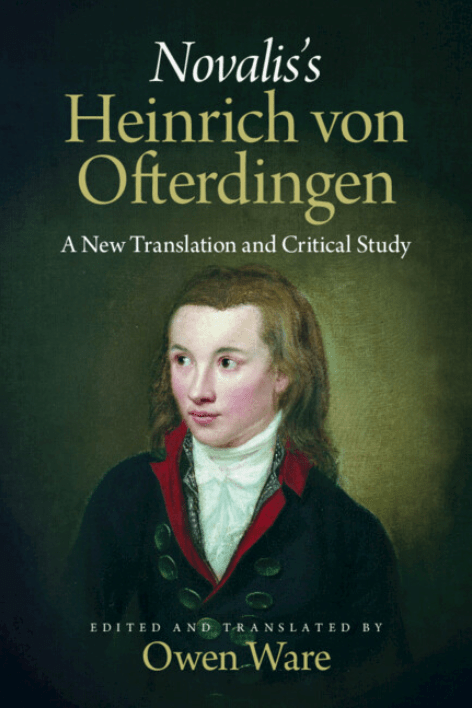
Today’s post is on Dr. Owen Ware’s exceptional new translation of Novalis’s novel Heinrich von Ofterdingen, a key text in early Romanticism. In addition to a beautiful translation, the new edition includes clear, readable, and detailed critical materials to help new readers of Novalis gain the most from this extraordinary text. In this post, I ask Dr. Ware to share a little of what makes Heinrich von Ofterdingen so special, the way this novel functions as a philosophical work, and how his new translation can help us appreciate Novalis’ philosophical and literary contributions.
Anna. What inspired you to develop a new translation of this book, and to create the website to accompany it?
Owen. The idea of translating the novel came to me while I was working on a book, now published, in which I examine the role of mythology in Romantic philosophy and literature. I came to realize that Novalis’s Heinrich von Ofterdingen is not only an extraordinary piece of philosophical fiction, but it also comes closest to fulfilling the idea of a “new mythology” that was so central to writers in both Germany and England around the turn of the 19th century.
I came to see the importance of this larger context for appreciating Novalis’s novel. In the wake of the French Revolution, a feeling spread across Europe and the British Isles that we could truly recreate ourselves, that the power of imagination wasn’t limited to producing artworks for enjoyment, pleasure, or distraction from daily life. Instead, it was believed that the imagination could create new forms of art capable of transforming human beings, healing fragmentation, and restoring a sense of unity. That’s really the broader intellectual background of Novalis’s Ofterdingen—an attempt to realize a Romantic vision of art that can change how we think and feel.
Much later on, the idea of putting together an accompanying website for the translation came to me. I was inspired by the thought that the website could simulate the experience of entering into the music and artistic worlds that shaped the background of Novalis’s novel. That’s why I devoted sections of the site to the late Medieval art and music that make up the quasi-historical context of the novel. I also wanted to give readers a sense of Novalis himself, so I included a brief chronology of his life, along with a schematic breakdown of the novel where readers can see its skeletal structure, identify the main characters, and follow the locations as the plot unfolds.
Anna. Heinrich von Ofterdingen describes the development of a young man, Heinrich, towards his calling as a poet, and is one of the central texts of early Romanticism. Why is this novel so important to Romanticism? And why should we read it as a philosophical text?
Owen. The reason I think Novalis’s novel is so important to Romanticism is how synthetic it is. By that I mean: yes, it’s a novel, a work of fiction, but even by the standards of fiction it’s remarkably radical in the way it experiments with genre. For example, there are more than a dozen poems embedded in the narrative, many of them appearing as songs sung by characters. As a reader, you move fluidly from reading a novel to reading poetry.
On a formal level, Novalis was a tireless experimenter with embedded or nested narrative: stories within stories, novels within novels, even visual descriptions of paintings contained within the text. That’s one illustration of how Novalis tries to write in a style and structure that reflects the philosophical ideas animating the work itself—the idea of ascending to ever-higher states of mind that contain yet expand beyond prior stages of our development.
As I see it, beneath the plot of Ofterdingen is an exploration of how the self originates, how we lose a sense of connection with nature and with others, and how we might regain that connection from a higher standpoint. Novalis works with the Romantic idea that the challenge we face is one of integrating reason and sensibility into a more complex form of harmony that still allows for individuality, differentiation, and particularity.
Anna. One of the distinctive ideas of Romanticism is the idea that human beings are fragmented and alienated from the world around them, and that they need to reconcile with this world. How does Novalis communicate this idea in Ofterdingen? How does he think we can begin to mend this rift between ourselves and the world?
Owen. In terms of how Novalis conveys fragmentation and the path to wholeness, the structure of the plot itself reflects Heinrich’s sudden sense that both he and the world around him have become strange and uncanny. Everything that once seemed familiar and homelike now appears unfamiliar, tinged with an atmosphere of the unknown. This awakens within him a sense of longing, and the journey he undergoes can be understood as an attempt to fulfill that longing. Now the fragmentation Heinrich feels takes different forms. At times, reason threatens to subordinate sensibility, producing a kind of excessive rationalism. At other moments, sensibility attempts to overpower reason, leading to excessive sensualism. The novel suggests that genuine harmony between these aspects of human nature can be achieved through art, poetry, and love.
That’s why, by the end of the story, Heinrich himself is meant to become a poet who has achieved reconciliation within himself, a harmonization of reason and feeling, intellect and sensibility. Having attained that state, he is someone whose poetry can awaken similar feelings of unity in others. In that sense, we see how the Romantic poet assumes traditional roles once associated with the prophet, the religious mediator, or even the “redeemer”: someone capable of bringing about genuine reconciliation for humanity through works of art.
Anna. What other ideas does Novalis develop in Ofterdingen, and why are they important?
Owen. I mentioned love alongside art and poetry, and I think that’s a crucial theme. As much as the novel conveys complex philosophical ideas shaped by Novalis’s engagement with Kant and early post-Kantian thinkers like Schiller, Fichte, and Schelling, there’s still a simple love story at the heart of Ofterdingen. And I think that’s what resonates most deeply with many readers. It’s the story of Heinrich falling in love with Mathilda and the transformative effect that experience has on him.
[Spoiler alert!]
As I came to realize, it’s not only Heinrich’s experience of falling in love with Mathilda that changes him, but also the experience of her death that plays such a crucial role in his spiritual development. The theme of the death of the beloved and its effect on the emerging poet alludes to the myth of Orpheus, which I think is essential for understanding Novalis’s work. You could say that Novalis offers a Romantic reinterpretation of the myth: Orpheus descending into the underworld to rescue his dead wife, gaining entry through the power of song and persuading Hades to grant her return.
That’s why I believe that love and death are two of the novel’s unifying themes, and it eventually became the organizing thread of the critical study I included alongside the translation. I argue that one way to understand the novel’s unity is as a story about the transformation of Heinrich’s capacity for love: beginning with eros, understood as longing, attachment, or striving, and eventually, through the death of the beloved, transforming into agape, a form of love associated with divine or unconditional giving rather than desire or striving. I take that transformation from eros to agape to be one of the clearest expressions of the novel’s philosophical-poetic vision.
Anna. In your new translation, you talk about the importance of Novalis’ writing style for conveying some of the central ideas of the text. Can you give some examples of how Novalis’ style is crucial to his thought? How did you cope with this as a translator?
Owen. Well, the truth is that I encountered many challenges. Modern readers will notice his long, sometimes cumbersome sentences that seem to go on endlessly. As a translator, I often felt tempted to shorten them or introduce paragraph breaks where none existed in the original. In an early draft, I actually did give in to that temptation, and the text certainly became more readable by contemporary standards. At a certain point, though, I decided to make the translation as faithful to the original as possible. So I allowed the sentences and paragraphs to unfold at their natural length because I came to see that they play an important role in creating a stream-of-consciousness effect, one that blurs the boundaries between waking life and dream life. Since dreams are such a key theme in the novel, I began to realize that Novalis often adapts his writing style to reinforce that atmosphere.
Anna. Novalis died in 1801 at the age of only 28, and famously did not finish writing the second part of the novel. I’ve always loved the unfinished nature of Heinrich von Ofterdingen, which feels full of promise and possibility. But I imagine the partially completed nature of the work could create a challenge for interpretation. How did you deal with this in your translation and the accompanying materials?
Owen. When I first learned that Novalis’s work on Ofterdingen was cut short due to his untimely death, I felt a mixture of emotions—sadness, yes, but also something like heartache. I still feel that, to be honest. But the attitude I have now was shaped largely by my students, who helped me see that there is something hauntingly poetic about the fact that the novel was left as a fragment—as you put it, it makes Ofterdingen a “promise and possibility,” and also—as several of my students have said—an invitation.
I would say that one of my core motivations for the critical study was to take up that invitation and offer readers the opportunity to peal back the many philosophical and symbolic layers of Novalis’s Ofterdingen. In that sense, my critical study is an invitation, too, open to anyone who wants to go deeper into the ideas and themes of the novel.
Anna. I couldn’t help but notice that you dedicated this book to your students. Do you mind sharing more details about this?
Owen. When I first began teaching Ofterdingen at the University of Toronto—this was back in 2022—I had no idea how my students would react to such a work. Since then, I’ve taught the novel more than half a dozen times in different courses, and every single time the reaction has been amazing. What moved me most was seeing that a sense of magic and mystery I felt in the work was not some quirk of mine. Students always became invested in Heinrich’s journey and emotionally engaged with the novel’s themes of longing, imagination, nature, love, and spiritual transformation.
I ended up incorporating a creative assignment into some of my courses in which students could produce a work of art in any medium inspired by their reading of the novel. The results were really beyond anything I could have expected. Students created short films, paintings, musical compositions, and original poetry. It was clear to me that they felt empowered to be creative, and they could see how creativity and rationality needn’t be at odds with one another.
At a time when many people feel increasingly disconnected from themselves, from nature, and from one another, these experiences in the classroom were special. There were moments when I found myself thinking: for all the cynics, pessimists, and skeptics who insist that experiences of beauty, transcendence, and shared meaning have disappeared from modern life, well, look at us! Students felt inspired to create, imagine, and participate in something larger than themselves. For me as a teacher, those moments remain among the most meaningful experiences of my career. If even a small bit of that magic and mystery comes through in this translation and critical study, I’ll feel that my project has achieved what I hoped for.
Anna. Do you have a favourite passage from your translation of the text? Please share! Why do you love it?
Owen. Here’s the first one that comes to mind:
What is religion but an infinite agreement, an eternal union of loving hearts?
What draws me to this passage is that it seems to be saying that love is the deepest form of reconciliation in the world. We may tend to think that religion divides and separates people along different systems of belief. For Novalis, though, true religion is love. Whatever we may think about religion, we can feel the force of Novalis’s conviction that love is what matters most in the end.
Dr. Owen Ware’s Novalis’s ‘Heinrich von Ofterdingen.’ A New Translation and Critical Study will be out on 9 July 2026 and is available for preorder from Cambridge University Press.
REFERENCES AND FURTHER READING
Ware, Owen. Novalis’s ‘Heinrich von Ofterdingen.’ A New Translation and Critical Study. Cambridge University Press, 2026.
Ware, Owen. Return of the Gods: Mythology in Romantic Philosophy and Literature. Oxford University Press, 2025.
Follow Trail of Crumbs
Get new content delivered directly to your inbox. Occasional entries on historical women philosophers, expanding the canon, and related topics in philosophy, literature, and fine arts.


Leave a Reply